Photodynamic Therapy
Photodynamic therapy is a technique which involves using cream and light to cure skin problems without leaving a scar. It is particularly useful for treating non-melanoma pre-cancers (e.g. solar keratoses, Bowens disease) and superficial basal cell carcinoma. It can also be applied to relatively large areas, which means it can treat, not only visible pre-cancers, but very early ones which are not yet visible.
Explore Topics On This Page
How is photodynamic therapy performed?
A special photosensitising cream is applied to the area to be treated. It is left on for a period of time ranging from 30 minutes to a few hours, depending on what is being treated. During this time it is important to protect the skin from excessive exposure to light, particularly strong sunlight, with clothing or dressings.
Following this, a selected light, either red or blue light from a light emitting diode (LED), is shone on to the skin for between 8 and 20 minutes. Usually this is not uncomfortable, but when used to treat skin cancers or severe acne it can be uncomfortable for the duration of the LED skin therapy treatment and an air cooler and/or pain relief tablets can reduce this. Sometimes, when being used as a cosmetic treatment, lasers are used as the light source instead.
What methods are used?
There are three possible methods:
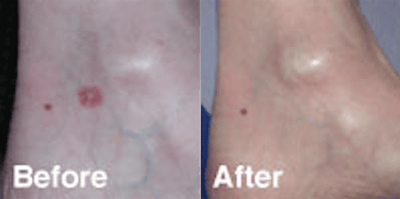
Standard Red Light Photodynamic Therapy: The skin is cleaned and exfoliated. Then a special gel called 5-aminolaevulinc acid (Ameluz®) or methylaminolaevulinic acid (Metvix®) is applied to the treatment area, then covered with a dressing or light-proof clothing to protect against light for three hours. The dressing is then removed and red light is shone on the skin for several minutes. The cream that has been taken up by the abnormal skin is activated by the light to destroy the cancerous and pre-cancerous skin cells. During this time there can be an intense tingling sensation and the more abnormal the skin problem that is being corrected, the greater the tingling sensation. After the treatment the treated site needs to be protected from sunlight/excessive light for 48 hours afterwards (with regular application of sunblock or a dressing). The skin is red and may form scabs but this settles after a week. It may be slightly pink for a couple more weeks like a mild sunburn. Afterwards the skin not only looks smoother and clear of skin cancer without any scars, but it also usually has a rejuvenated appearance because photodynamic therapy has also been shown to improve the cosmetic appearance including fine lines and skin texture.
Daylight Photodynamic Therapy: The skin is cleaned and exfoliated and sunscreen applied. The Ameluz® gel is applied to the site to be treated and within 30 minutes the patient sits outside in sunshine for two hours. Following that the gel is washed off and sunscreen applied and the skin needs to be protected from sun and excessive light for 48 hours. There is redness and crusting similar for a week, similar to that occurring after the red light PDT. Advantages are that daylight PDT does not hurt and feels like a slight tingling and also large areas (e.g. face, scalp, chest, hands and arms) can be treated at the same time. However, it can only be done from April to October.
Indoor Daylight Photodynamic Therapy: This is a more recent method which aims to simulate the effects of natural daylight. The current protocol is to apply the Ameluz® gel, then 35 minutes later the patient lies on a couch with protective eye goggles while red, then blue, then yellow LED light is shone on the skin for one hour to simulate the effect of natural daylight. There is some mild tingling, but it should not be painful. After the hour the gel is washed off and sunscreen applied and the skin is protected from excessive light for 48 hours. The skin undergoes similar healing process to that of the red and daylight PDT. One advantage to indoor daylight PDT can be done all year round, but as the light device has a limited size there is a limit as to how large an area can be treated each hour.
Red light PDT is the only version suitable for superficial basal cell carcinoma and Bowen’s disease. Red light, daylight and indoor daylight can be used as a very effective treatment option for pre-cancerous skin lesions (actinic/solar keratoses) with the added benefit of improving the cosmetic appearance if the skin.
Photodynamic therapy is also sometimes used to treat non-skin cancer problems, such as acne and viral warts.
What care is needed after treatment?
Following the light or laser treatment the skin needs to be protected from sunlight for 24 to 48 hours until the photosensitising cream becomes inactive, as over exposure to sunlight can cause sunburn-like rashes. Following treatment the skin may be red, swollen, crusted and flaky for a few days, then heals leaving smooth skin.
What is Daylight PDT?
Daylight PDT involves applying the porphyrin cream to the skin and then 30 minutes afterwards sitting outdoors in sunshine to activate the cream. One advantage is that the slower, more gradual exposure to the light means that it is less uncomfortable during the procedure. The disadvantage is that it is dependent on the weather and can only be done optimally from April to October.
Testimonials
“Dr Anne Farrell is an exceptional dermatologist who has transformed my skin.”
What is the outcome?
The advantage of this treatment is that it usually produces an excellent cosmetic result and so is also now being developed as a cosmetic treatment. It can also be an effective treatment for acne and enlarged oil glands.