Treatments for Scars including Lasers
Scars can be a very distressing reminder of previous injury to the skin and occur when several layers of the skin are injured, usually as a result of injury, surgery, or acne. The cosmetic concerns associated with scars occur because they may appear red, white, depressed, or raised (hypertrophic or keloid scars).
In addition to cosmetic concerns, some scars can also cause physical symptoms, including itching, pain, and restriction of movement. Until recently, very little could be done to help improve scars. However, in the last few years, advances in laser technology have revolutionised treatment options and can now significantly improve the appearance of scars.
At Dermatology Consulting, we are able to offer a multidisciplinary approach to scar treatment. Dr Farrell has a particular interest in the treatment of scars and attends some of the foremost world conferences on scars, as well as visiting overseas centres of excellence to offer the most advanced laser treatments. Our plastic surgeons, Mr Nick Parkhouse, Mr Asit Khandwala, and Miss Jennifer O’Neill also have an interest in the surgical revision of scars and wound healing. Mr Parkhouse completed a doctoral thesis on this subject and also acts as an expert witness in this area.
Every scar has individual properties, and the treatment plan will depend on the unique aspects of that scar.
Explore Topics On This Page
- Red Scars
- Dark Scars
- Microneedling
- PicoWay® Laser
- Fraxel® Restore
- Fractionated CO2 Laser (Ultrapulse® Alpha and Fraxel® Repair)
- Fractionated Erbium Laser (Fotona SpDynamis)
- Intralesional Injection of Steroid and 5-Fluorouracil
- Laser Assisted Drug Delivery
- Surgical Treatment (Subscision or Scar Revision)
- Combination Treatment Including At Home Treatment
- What Other Scar Treatments Are Available?
- Results
Red Scars
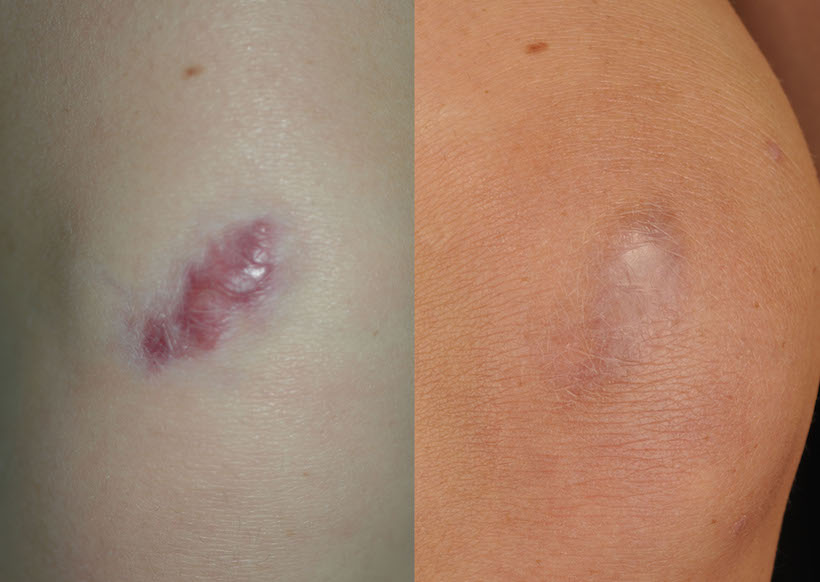
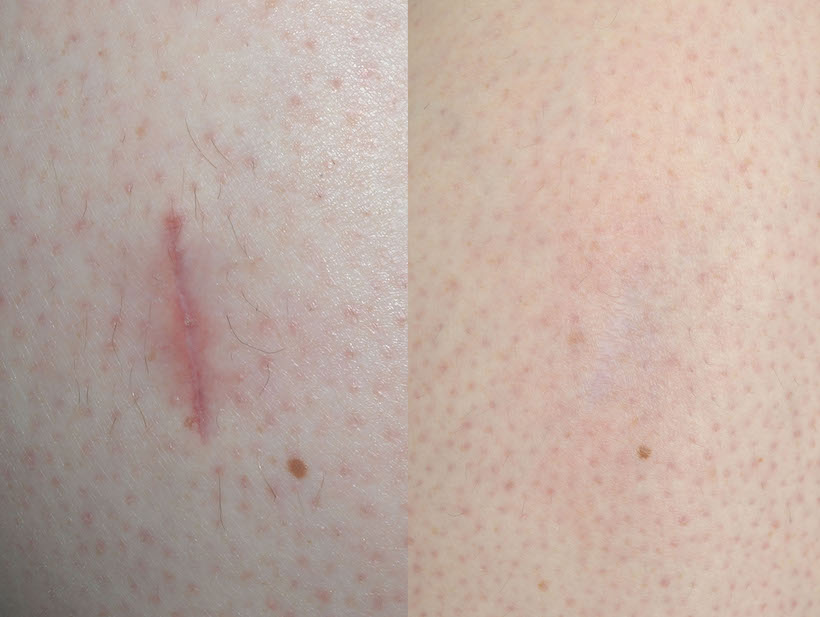
The redness of scars can be reduced by the pulsed dye laser or KTP laser. Gentle settings are used (gentler than those used to treat birthmarks in babies) to heat up and reduce the dilated blood vessels which are causing the redness. It has also been shown that the earlier the pulsed dye laser or KTP laser is used on a scar (ideally when it is a few days old) the less noticeable the scar will be and the less likely that it will grow into a hypertrophic or thickened scar.
Usually, one or two sessions are needed at intervals of 3-4 weeks. The scar may look slightly pinker or slightly bruised for a few days after the treatment.
Dark Scars
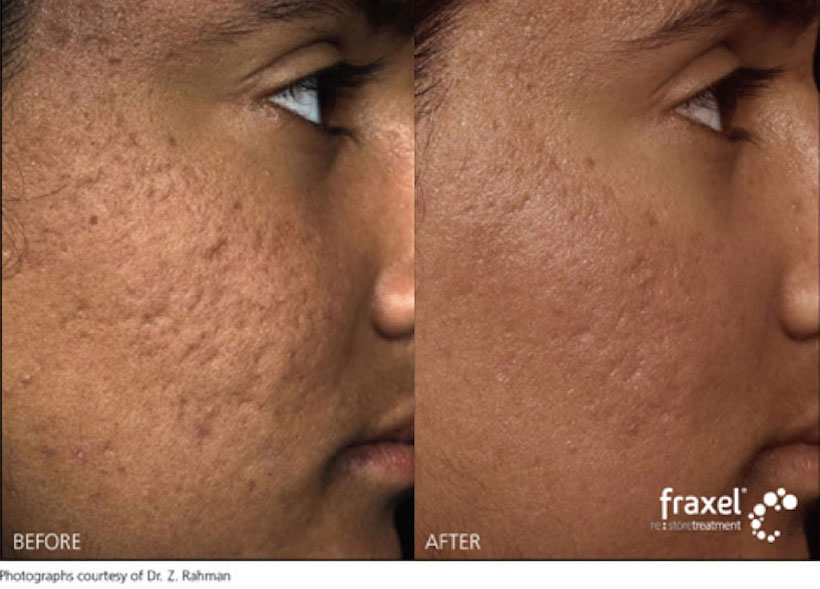
If scars have excess pigment this can be reduced by the PicoWay® laser or the Fraxel® Restore laser with 1927nm wavelength. The PicoWay® has very little recovery time. The Fraxel® Restore with 1927nm wavelength causes very slight pinkness and swelling of the scar and over the next few days the pigment is pushed out of the scar as darker speckles.
Microneedling
Microneedling (using tiny needles which vibrate up and down to create small fractionated breaks in the skin) can be helpful to improve the texture of scars. There is mild pin point bleeding and pinkness for 24-48 hours. It is done after applying local anaesthetic cream. Microneedling can be done on skin of all colour and does not usually result in any temporary pigment change.
Approximately six microneedling sessions are equivalent to one Fraxel® Restore session.
PicoWay® Laser
The PicoWay® laser is so superfast that it generates pulses of laser to create tiny bubbles of gas which create tiny gaps in the skin in a fractionated pattern. These tiny gaps stimulate the production of new collagen to replace the old scarred collagen.
It is not uncomfortable and does not require local anaesthetic and feels like warm sparkles on the skin. There is usually little or no recovery time (although occasionally there can be some slight pinkness and pinpoint blood spots under the skin for a couple of days). It can be done in skin of all colour and does not usually affect skin colour. This makes it suitable for patients of all ages and skin types.
Approximately four sessions of PicoWay® laser are equivalent to one session of Fraxel® Restore.
Fraxel® Restore: A Non-Ablative Fractionated Laser
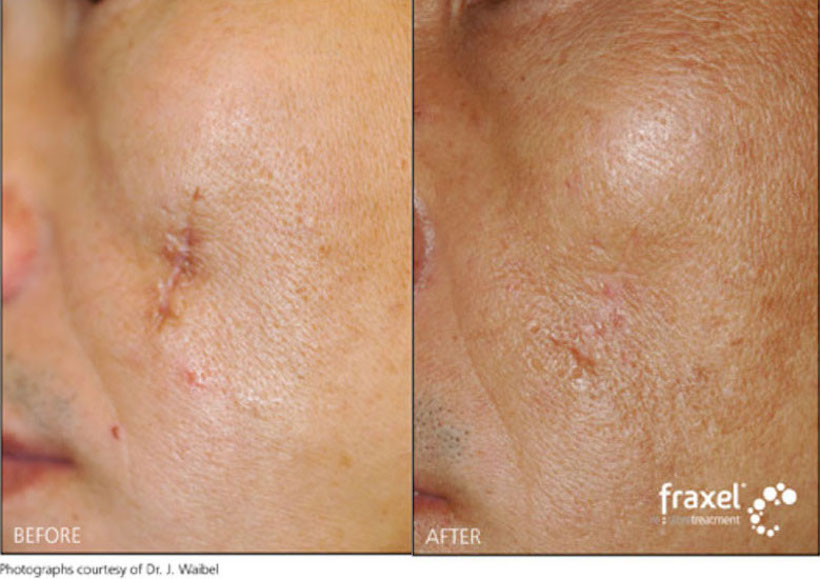
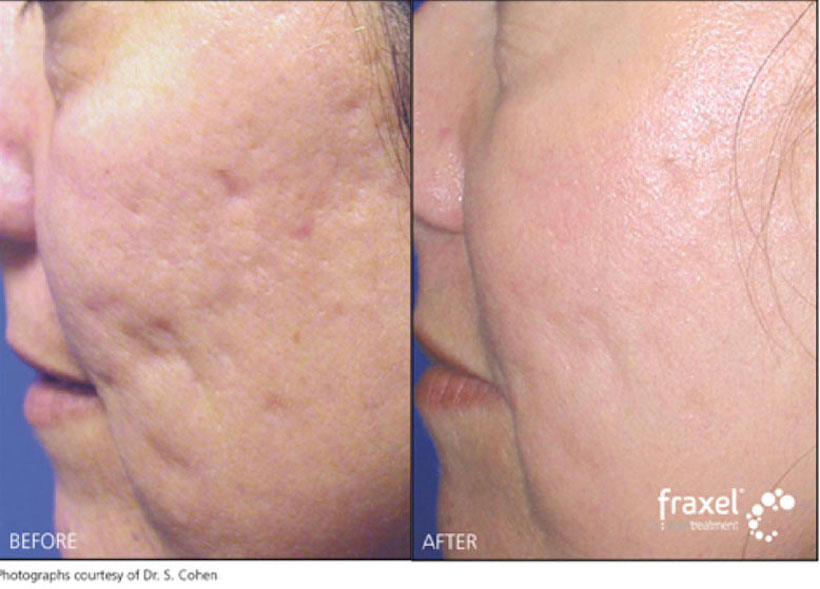
The Fraxel® Restore using the 1550nm wavelength puts tiny beams of heat less than the diameter of a hair into the skin to heat tiny columns of skin. These columns of skin are pushed out over the next few days by the skin’s natural healing process and replaced by new fresh collagen, replacing parts of the scarred collagen.
The skin is pink and swollen for 7-10 days afterwards, but the skin is not broken or bleeding. Makeup can be worn afterwards.
In patients with darker skin there may be slight darkening of the skin afterwards, but this settles after a couple of weeks.
Local anaesthetic cream is usually applied beforehand. As it treats a fraction of the skin, several sessions will be needed, which can be done at intervals of two weeks (or more if desired).
Fractionated CO2 Laser (Ultrapulse® Alpha and Fraxel® Repair)
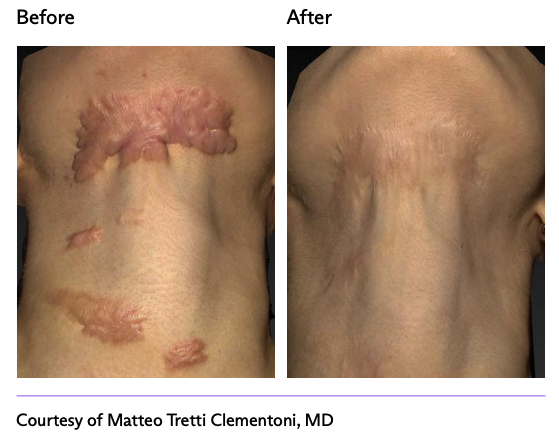
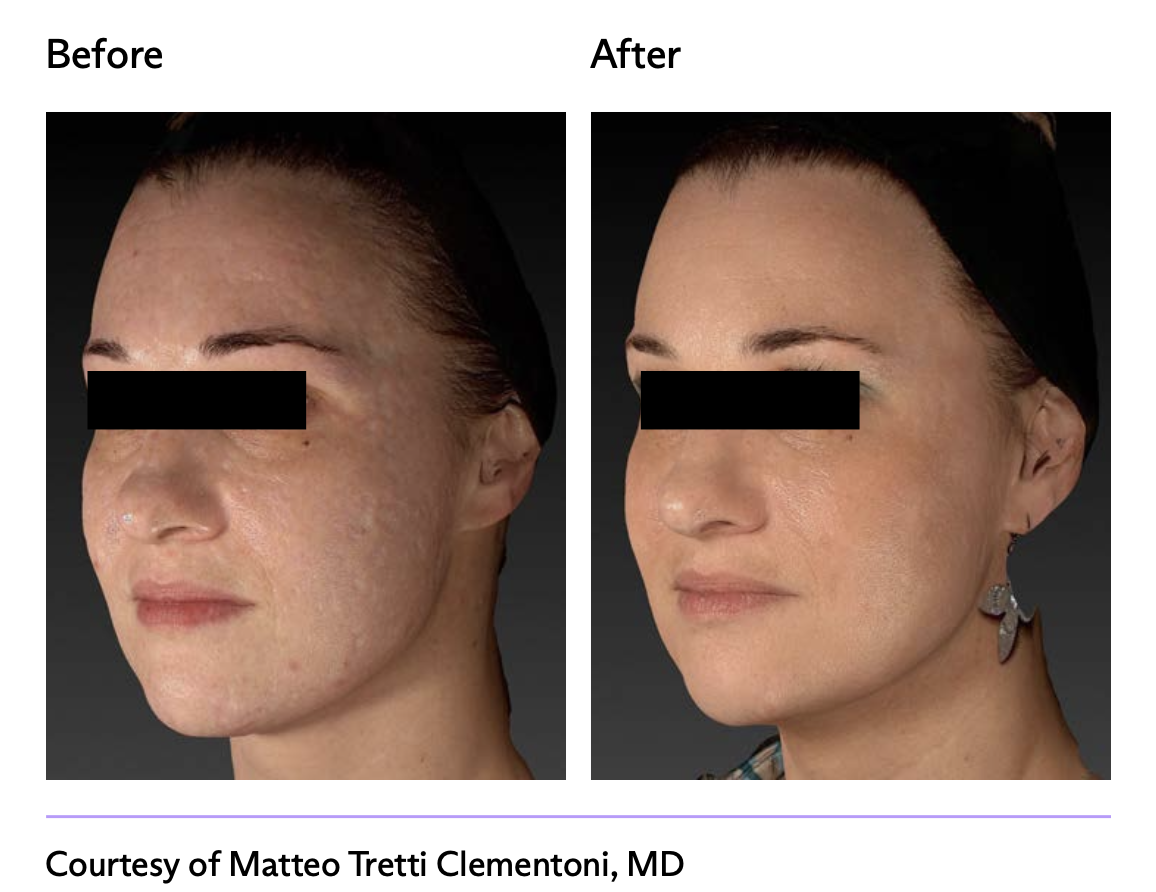
CO2 lasers remove the tissue that they heat. When used in a fractionated way (i.e. to make tiny holes into the skin less than the diameter of a hair) they remove the old scarred collagen and replace it with new fresh collagen. This allows remodelling of the scar. It also reduces the tension on the scar.
At Dermatology Consulting we have two Fractionated CO2 Lasers – the Ultrapulse® Alpha by Lumenis and Fraxel® Repair.
The Ultrapulse® Alpha is widely regarded as the most advanced, versatile and powerful CO2 laser. It also goes the deepest of any CO2 laser so it is able to treat very thick scars. It has a variable spot size and beam shape so it can be used easily on scars of all shapes. Furthermore the spot size can be changed quickly so the laser treatment can be designed and performed precisely where the scar is and avoid normal skin.
There is usually some pin-point bleeding for a day or two afterwards and pinkness for a couple of weeks.
At least three sessions are usually needed.
The Fraxel® Repair is another brand of fractionated CO2 laser. It can be used for large areas such as the entire face and is rolled over the skin four times for even coverage.
The fractionated CO2 (Ultrapulse® Alpha and Fraxel® Repair) lasers give more rapid and noticeable improvement than the other forms of laser but there is more recovery time.
Fractionated Erbium Laser (Fotona SpDynamis)
Erbium lasers remove the skin with less heating than CO2 lasers. They do not cause as much redness or temporary darkening as the CO2 laser but cannot go as deep. They can be useful in individuals with very dark skin, who may have prolonged skin darkening after the fractionated CO2 lasers.
Intralesional Injection of Steroid and 5-Fluorouracil
Steroid injections into raised scars can be used to flatten them and stop them becoming more raised. A possible side-effect is that this can lead to the scar developing threadveins or further redness, but this can be corrected afterwards with lasers. 5-Fluorouracil, which is a chemotherapy drug, can also be used as injections to help flatten scars and stop them become raised. It is less likely to cause redness and thread veins but the injection can be sting more than steroid injection and it can cause the skin to lose its pigmentation. We often combine steroid and 5-Fluorouracil in the same syringe, which is less likely to cause the flattening and redness of steroids and the pigment loss of 5-Flourouracil.
Laser Assisted Drug Delivery
One advantage of the fractionated CO2 lasers is that they can be used to deliver chosen drugs into the scar to provide additional benefit.
In particular, steroid and /or 5 Fluorouracil can be delivered into the skin through the holes created by the CO2 laser. These can flatten and soften an elevated or thickened scar.
Sculptra can be applied into the holes to stimulate collagen production in indented scars.
Bimatoprost can be applied to white scars to help restore pigmentation.
Surgical Treatment (Subcision for Scar Revision)
Sometimes additional physical treatments are needed. If scars are very tethered down, the adhesions pulling the scars down can be released by using a sharp instrument under the base of the scar to loosen the adhesions. This is usually done after application of a local anaesthetic cream or injection of anaesthetic.
Sometimes scars are so large and thickened (e.g. large keloid scars on the chest), or have sharp edges that are hard to smooth out with lasers (e.g. deep “ice-pick” scars with sharp edges from acne) that surgical removal of the scar to replace it with a neat fresh surgical scar is the most efficient approach. The new fresh scar can then be treated with pulsed dye laser and/or fractionated laser to fade it.
Combination Treatment Including At Home Treatment
Scars can vary greatly in their appearance and texture and often have more than one feature. Usually the best results require a combination of treatments e.g. pulsed dye or KTP lasers for redness, PicoWay® laser for pigmentation, subscision to loosen tethering, surgical revision and fractionated lasers for texture or laser assisted drug delivery. At home treatments (including massage, silicon tape, silicon gel, steroid tape) can also have benefits and work alongside the other treatments.
A bespoke treatment plan can be drawn up at the initial consultation depending on the appearance of the scar.
What Other Scar Treatments Are Available?
A number of treatments are now available depending on the type of scar, and treatment may include a combination of different methods. Silicone gel or sheets can help mild or fresh scars. Creams and injections can help raised or itchy scars. Deeper scars can be removed by punch excision and rolling scars can be released by subcision. Depressed scars can be helped by prescription strength Vitamin A creams, chemical peels and dermal fillers such as hyaluronic acid.
To learn more about treatment of specific scars, Contact Dermatology Consulting today to arrange an appointment.